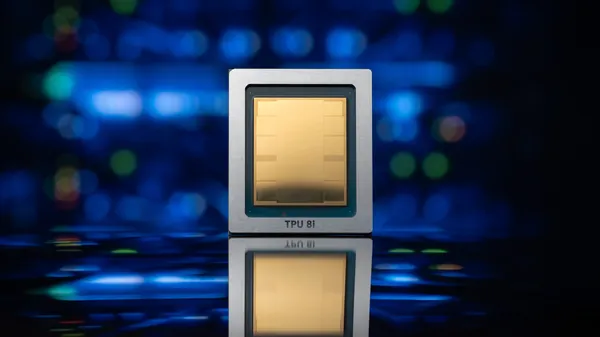

If you’ve used Google Search, Gmail, or YouTube today, you’ve already touched hardware most people never think about. Those products run on custom chips Google designed specifically for one thing: doing math at a scale that would choke any general-purpose processor.
They’re called TPUs — Tensor Processing Units. And they’ve been around for over a decade now, though Google doesn’t make a big song and dance about them.
The idea is simple enough. AI models are just enormous chains of matrix multiplications. Normal CPUs and GPUs can handle that, but they’re doing a lot of other things too. A TPU strips away everything unnecessary and focuses purely on the math that matters for neural networks. It’s purpose-built, and that shows in the numbers.
The latest generation hits 121 exaflops of compute power. Let me put that in perspective: an exaflop is a billion billion operations per second. 121 of those? That’s higher than I expected, honestly. They also doubled the memory bandwidth compared to the previous generation, which is often the real bottleneck in large model training — not raw compute, but how fast you can feed data into those compute units.
There’s a video embedded in the original post that walks through the design philosophy, but the takeaway is this: Google isn’t just buying off-the-shelf AI accelerators. They’re building their own, iterating aggressively, and the gap between what they can do and what commodity hardware can do keeps growing.
Of course, this approach has been tried before. Custom silicon is expensive and risky. Most companies can’t justify the R&D for a chip that only does one thing. But when you’re running AI across billions of users daily, the economics shift. The upfront cost becomes worth it when you control the entire stack — from the model architecture down to the transistors.
What I’d like to see is more transparency about real-world performance. Flops are a marketing number. I want to know inference latency at scale, power efficiency per query, and how these TPUs handle the kind of messy, production-grade workloads that don’t fit neatly into benchmarks. But for now, the raw specs are impressive enough to keep Google’s AI ambitions well-fed for the next few years.
Comments (0)
Login Log in to comment.
Be the first to comment!