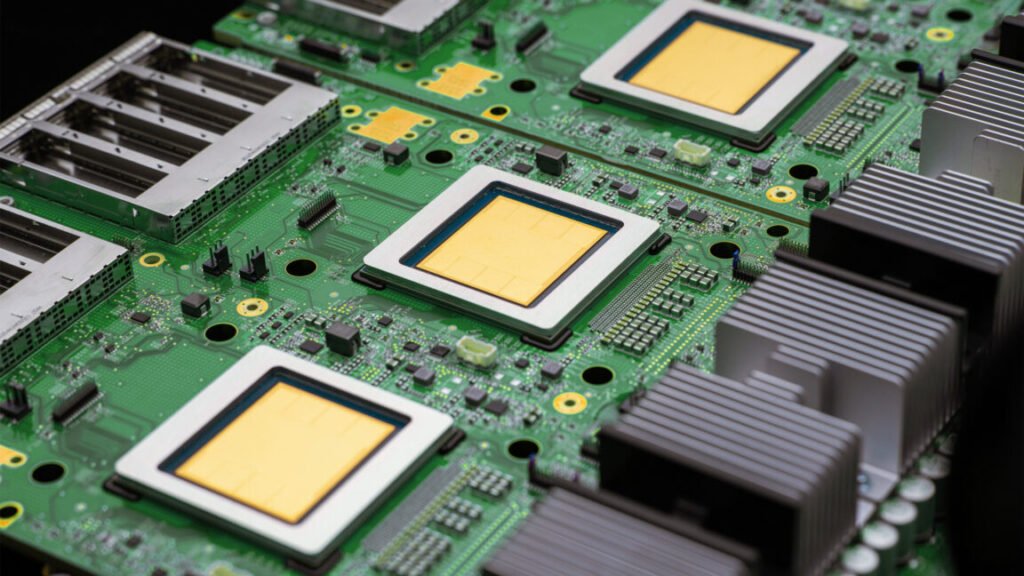

Every company building AI models is hoovering up Nvidia accelerators like there’s no tomorrow. Google, as usual, went its own way. Its cloud infrastructure runs mostly on custom Tensor Processing Units (TPUs). After the seventh-gen Ironwood dropped in 2025, you’d expect an eighth-gen to just be faster. But Google is splitting the lineup into two distinct chips.
The TPU8t is for training. The TPU8i is for inference. That’s not just marketing fluff.
The reasoning is actually pretty interesting. Google is pushing the idea that the “agent era”—where AI doesn’t just answer questions but takes actions, uses tools, and makes decisions—has fundamentally different hardware demands than the earlier wave of chatbots and image generators. Training a frontier model is a brute-force marathon. Inference for agents is a real-time, low-latency sprint where you’re constantly calling models, parsing outputs, and chaining steps.
So the TPU8t is built to compress training time from months to weeks. That’s a massive leap if it holds up. The TPU8i, on the other hand, is optimized for serving those models quickly and efficiently, especially when they’re being used in agentic workflows that require rapid back-and-forth.
I’ve seen this kind of specialization before—Nvidia has different SKUs for training and inference too—but Google is the first to publicly frame it around the agent paradigm. Whether that’s a genuine architectural insight or just a good story to tell investors is debatable. But the hardware split itself makes sense. Training and inference are different workloads, and pretending one chip can do both perfectly is a compromise.
That said, the real question is whether Google can get these chips into enough hands. TPUs are mostly locked inside Google Cloud. If you’re not already a GCP customer, this doesn’t change much for you. And Nvidia isn’t exactly standing still. But for teams already building agent systems on Google’s stack, this could be a meaningful upgrade.
I’ll be watching to see if the TPU8i actually delivers on the latency promises. Agentic AI is still early, and the hardware that wins will be the one that makes agents feel fast and reliable—not just powerful on paper.
Comments (0)
Login Log in to comment.
Be the first to comment!