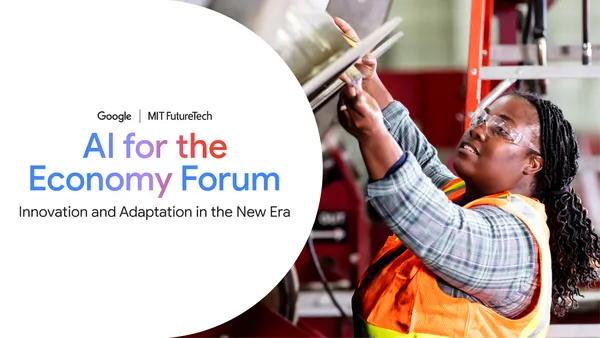

Google and MIT FutureTech just wrapped their first AI for the Economy Forum in Washington D.C., and for once, the tone wasn’t the usual Silicon Valley boosterism. The premise they started with is refreshingly honest: neither the benefits nor the risks of AI are automatic. We get to shape this thing, or screw it up, together.
James Manyika, Google’s SVP of Research, Labs, Technology & Society, announced two concrete moves: new research investments to help governments and companies make informed decisions, and training programs to give workers actual skills for a changing economy. No vague promises about “democratizing AI” or “empowering everyone.” Just money and programs.
The Research Side: Funding Real Answers
The AI & Economy Research Program is the centerpiece. They’re bringing in visiting fellows like MIT’s David Autor (who’s been doing solid work on how technology actually affects jobs, not just speculating). The Digital Futures Project already funded research from MIT’s Ben Armstrong and Julia Shah on what makes AI tools actually useful for workers. Their finding? The most successful uses minimize drudgery, promote learning, and foster collaboration. Shocking, right? But someone had to prove it.
Google.org is now funding a new cohort of researchers with both grants and Google Cloud credits. They’re looking at everything from how generative AI affects knowledge-worker productivity to the economics of AI agents. The academic advisory board reads like a who’s who: Nobel Laureate Michael Spence, Cambridge’s Dame Diane Coyle, and Mohamed El-Erian. That’s serious firepower, not just AI cheerleaders.
What I like here is the focus on sector-specific questions — manufacturing, healthcare, labor markets. We don’t need more general hand-wringing about AI taking jobs. We need granular data on what’s actually happening in factories and clinics.
The Training Side: Where the Rubber Hits the Road
The training piece is less flashy but probably more important. Making sure people have access to skills is the hard, unglamorous work that determines whether AI widens or narrows inequality. Google’s putting money into healthcare worker training and apprenticeships in high-demand fields. No details yet on scale or specific curricula, which is frustrating, but the direction is right.
I’ve seen too many corporate “reskilling initiatives” that amount to a few online courses nobody finishes. If Google can show real outcomes — people getting better jobs, wages going up — that would be meaningful. If it’s just PR, it won’t move the needle.
The Bigger Picture
This forum matters because the conversation around AI and the economy is still dominated by pundits with strong opinions and weak data. We need more of this: economists, industry leaders, policymakers, and researchers in the same room, comparing notes on what we actually know. The risks are real — job displacement, inequality, power concentration. But so are the opportunities if we get the policy and training right.
My take? Google’s doing something right here by funding research that doesn’t have to conclude AI is wonderful. They’re also acknowledging that training can’t be an afterthought. The proof will be in the results, not the press release. But it’s a better start than most tech companies have managed.
Comments (0)
Login Log in to comment.
Be the first to comment!